Proper teaching your child can work through independently. You facilitate, you don't have to be the maths expert. Foundation and Higher tiers. Family pricing available.
Home educating most subjects? Manageable. Home educating GCSE Maths? That's where many parents hit a wall.
You know the options. Expensive distance learning courses at £1,500 or more. Private tutors at £50 an hour. Or piecing together free resources and hoping you've covered everything. None of these feel quite right.
This course offers something different.
It's a complete, structured curriculum covering everything needed for GCSE Maths. But unlike workbooks that assume someone will explain first, or video sites that demonstrate without really teaching, this course actually teaches each concept from first principles. Your child can work through it independently, getting help from built-in hints when they're stuck.
Tracy Davis, a UK-qualified maths teacher with over 30 years of experience (including extensive work with students who struggled in mainstream settings), designed every lesson for clarity and patience. The explanations work for all learners, including those who need a bit more time or a different approach.
You stay involved as much or as little as you choose. Progress tracking shows exactly where your child stands. Discussion points make it easy to talk through concepts together or use in a co-op setting. And family pricing means multiple children can access the course without multiplying the cost.
This course works well for home educators who want structured GCSE preparation without having to teach the maths themselves.
Most home educating parents reach a point where facilitating maths gets harder. Maybe it's when the algebra starts looking unfamiliar. Maybe it's when your child asks "why does this work?" and you're not sure how to explain. Maybe it's just the sheer volume of content that needs covering for GCSE.
This isn't a failure. GCSE Maths covers a lot of ground, and most adults haven't used half of it since they left school themselves.
The usual solutions don't quite work. Free resources like YouTube videos and revision websites are helpful for specific topics, but they're not a curriculum. Your child can watch a video on quadratics, but who decides what to learn next? How do you know if they've actually understood it? How do you track what's been covered?
Workbooks and textbooks provide practice, but they assume someone has already explained the concepts. That someone is supposed to be you, and if you're not confident with the maths, the whole system falls down.
Distance learning courses offer structure, but at £1,500 to £2,500, they're out of reach for many families. Private tutoring helps, but £40-60 per hour across two years of GCSE content adds up to thousands.
There's a gap in the middle. A complete curriculum that actually teaches, designed for independent learners, at a price that works for home educating families.
That's what this course provides.
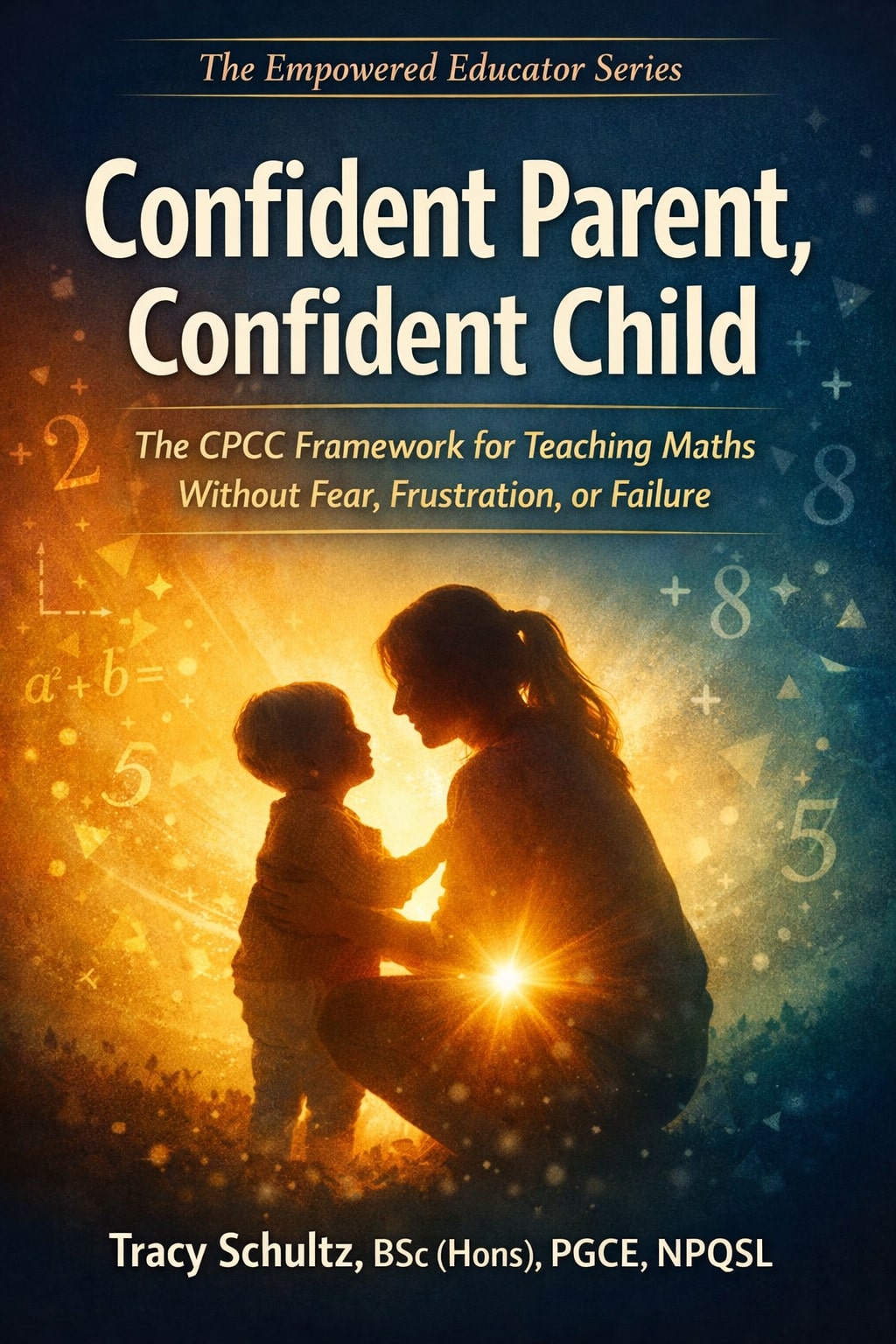
If the thought of supporting your child's maths learning fills you with dread, you're not alone. Many home educating parents carry their own difficult relationship with mathematics from their school days.
Confident Parent, Confident Child is Tracy's guide to transforming your own confidence in just 30 days — so you can be the calm, capable guide your child needs, even when the maths gets hard.
The book comes with a free resource pack including worksheets, assessment tools, and quick-reference cards to support your journey.
Built for independent learners. Designed by a teacher who understands that one size doesn't fit all.
Each lesson explains concepts from first principles, not just shows how to do questions. Your child learns why methods work, building genuine understanding that transfers to unfamiliar problems. This isn't a video library or a drill app. It's proper teaching.
The course assumes no classroom, no teacher standing by, no parent who remembers A-level maths. Everything is self-contained. When your child gets stuck, progressive hints guide them forward. They can work through lessons completely independently.
Tracy Davis has over 30 years of teaching experience, including extensive work in alternative provision settings with students who struggled in mainstream education. She understands that different learners need different approaches. The explanations are clear, patient, and designed to work for everyone.
46 units covering the entire GCSE syllabus in a logical sequence. No more wondering what to cover next or whether you've missed something important. Foundation and Higher tiers properly differentiated. Works for all UK exam boards.
Family pricing covers up to 4 children in the same household for one reasonable price. Co-op pricing available for small groups studying together. Each child gets their own login and progress tracking. Home education reality, reflected in pricing.
Quizzes show exactly which topics are understood and which need more work. You can see progress without micromanaging. And if the local authority ever asks for evidence of learning, you have it.
A complete curriculum in 46 structured units. Clear teaching, guided practice, and progress tracking throughout.
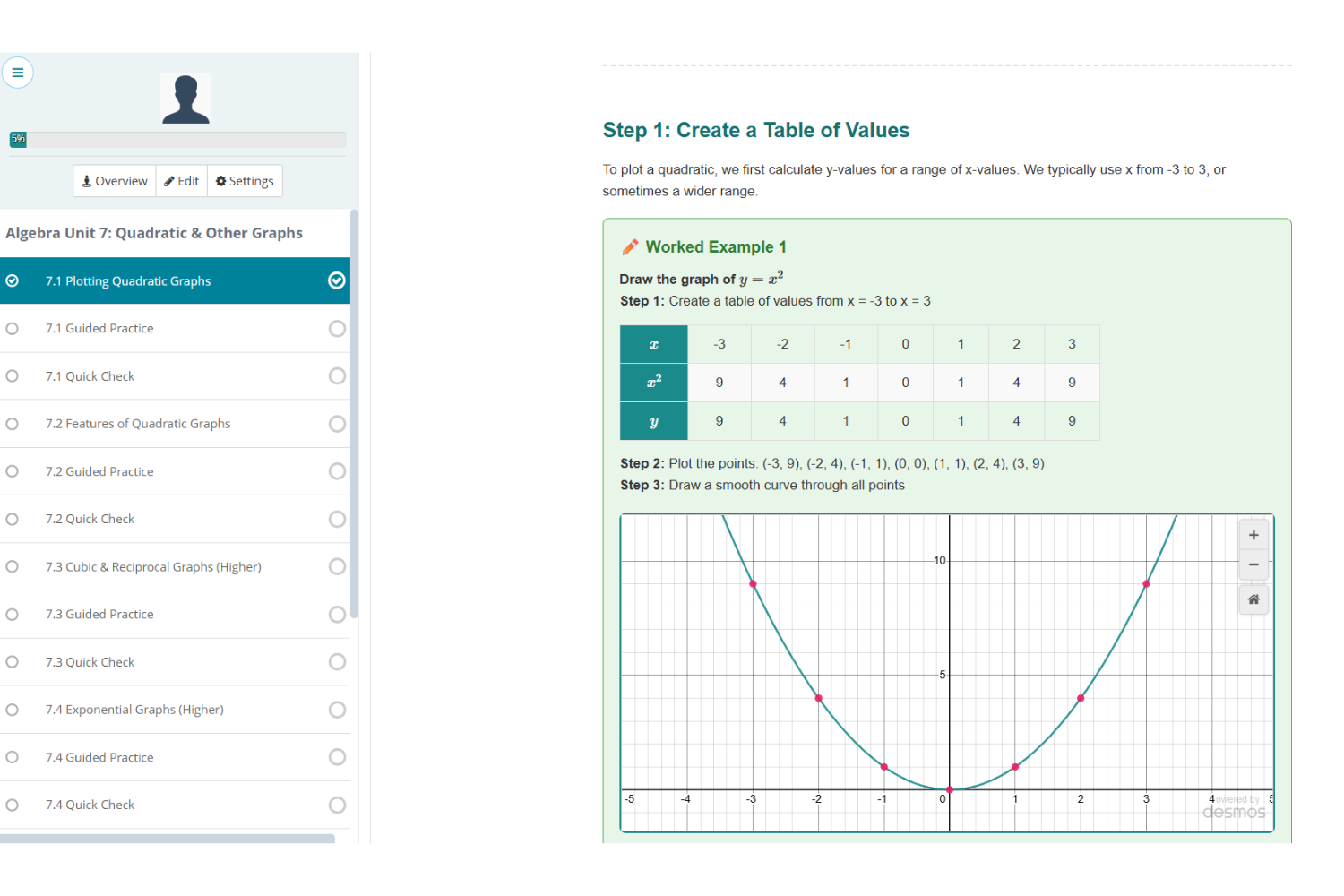
Each topic starts with clear explanations and worked examples before any practice. Concepts are broken down into manageable pieces. Your child learns the "why" behind methods, not just the "how."
"Try It Yourself" questions come with progressive hints. If your child gets stuck, Hint 1 gives a nudge. Hint 2 provides more support. The full solution is available after attempting. They can work independently without needing to ask you every time.
Foundation tier (grades 1-5) provides more scaffolding and step-by-step support. Higher tier (grades 4-9) covers the full curriculum including advanced topics. Complete Access includes both, so your child can work at the right level for each topic.
Interactive graphs bring algebra and geometry to life. Drag sliders to see how values affect equations. Visualise transformations. Explore coordinate geometry. Abstract concepts become concrete.
Links to trusted external resources like Corbett Maths and BBC Bitesize throughout. If one explanation doesn't click, there's always another approach. Your child has multiple pathways to understanding.
Unit quizzes show which topics are solid and which need more attention. Progress saves automatically between sessions. You can check in without hovering. Evidence of learning is there when you need it.
Lessons include clear discussion points, perfect for co-op sessions or parent-child conversation. If you're facilitating a small group, you'll know exactly where to pause and talk through concepts together.
Study at any time, from any device. Lessons are 10-15 minutes each. Your child can work in short bursts or longer sessions. No fixed schedule, no year group assumptions. The course adapts to your home education approach.
Get early access and start learning as new content is released.
Choose Your PlanA proven structure that builds understanding. Designed for independent learners.
Clear explanations break down each topic. Worked examples show step-by-step reasoning. Interactive graphs and diagrams make abstract ideas concrete.
"Try It Yourself" questions with progressive hints. Your child works through problems independently, getting support when stuck.
A short quiz (5 questions) confirms understanding before moving on. Instant feedback shows what's correct and what needs another look.
Bronze, Silver, and Gold practice sets offer different levels of challenge. Full worked solutions available after each attempt.
A summative assessment covering the full unit. Results track to the progress dashboard, showing exactly which topics need more attention.
The course works well for small groups studying together. Here's how co-ops typically use it:
Students work through the lesson content independently at home, up to a designated stopping point.
The group discusses concepts together, works through practice problems, and helps each other with tricky questions.
Students complete the quick check and practice sets independently, then compare results at the next meeting.
Choose the tier that matches your child's target. Not sure? Complete Access gives you both.
Target Grades: 1-5
Foundation tier focuses on building solid understanding of core concepts. Explanations are more detailed, with extra scaffolding and step-by-step support. Questions are accessible, designed to build confidence before increasing challenge.
Best for: Students aiming for a grade 4 or 5, those building foundations before potentially moving to Higher, or learners who benefit from a more gradual approach.
Foundation + Higher
Not sure which tier? Working at different levels for different topics? Complete Access includes both Foundation and Higher content, giving maximum flexibility.
Best for: Students unsure which tier suits them, those working at different levels across topics, or families who want flexibility.
Target Grades: 4-9
Higher tier covers the complete GCSE curriculum, including the more demanding topics needed for top grades. Less scaffolding, more problem-solving challenge. Questions require deeper understanding.
Best for: Students targeting grades 6-9, those considering A-Level Maths, or learners ready for more challenge.
If your child is preparing for iGCSE rather than GCSE, the mathematical content is almost identical. This course covers the national curriculum which maps directly to iGCSE specifications. The concepts and methods are the same. We're developing a dedicated iGCSE course for the future, but in the meantime, this course provides excellent preparation for iGCSE Maths.
46 units across 6 courses. Everything your child needs to learn, in a logical sequence.
The course prepares students for all three GCSE Maths papers: Paper 1 (non-calculator), Paper 2 (calculator), and Paper 3 (calculator). Content works for AQA, Edexcel, OCR, and WJEC exam boards.
BSc (Hons) · PGCE · QTS · NPQML · NPQSL · Enhanced DBS
This course is designed and taught by a UK-qualified mathematics teacher with over 30 years of classroom experience in British and international schools.
Tracy has worked extensively with students who struggled in mainstream education, including those in alternative provision settings. She has experience supporting neurodiverse learners, students with anxiety, and young people who need a different approach to thrive. This background shapes everything about the course: the patient explanations, the clear structure, the assumption that different learners need different things.
Her teaching focuses on understanding why methods work, not just following steps. This deeper understanding is what makes knowledge stick and helps students tackle unfamiliar problems with confidence.
"S has grown leaps and bounds when it comes to tackling her maths. We couldn't be more thankful for all the support and encouragement over the past year."
"I cannot begin to tell you how grateful I am to the time and thought you give G. It has made both a massive difference and a huge help. G has definitely become more comfortable and confident."
If your child is home educated, they'll sit their GCSE as a private candidate at an approved exam centre. We know this process can feel confusing at first.
The course prepares your child thoroughly for the exam itself. When it comes to the logistics of booking and sitting the exam, we can advise and point you in the right direction. We're actively building relationships with exam centres that welcome private candidates, and we're happy to help you navigate the process.
If you have questions about exam arrangements, get in touch. We understand the home education journey and we're here to help.
Contact Us About Exam ArrangementsIndividual, family, and co-op pricing available. AWE members receive 20% off.
Subscribe now and start learning immediately with the content already available. New units are being added regularly, and you'll have access to everything as it's released. Same pricing — just earlier access.
Subscribe monthly for flexibility, or save 20% with an annual plan. Cancel anytime.
Grades 1-5
Best for: Students aiming for grade 4 or 5, or building foundations.
Foundation + Higher
Best for: Flexibility to work at the right level for each topic.
Grades 4-9
Best for: Students targeting grades 6-9, or considering A-Level Maths.
Grades 1-5
Best for: Students aiming for grade 4 or 5, or building foundations.
Foundation + Higher
Best for: Flexibility to work at the right level for each topic.
Grades 4-9
Best for: Students targeting grades 6-9, or considering A-Level Maths.
For families with multiple children (up to 4 in the same household). Each child gets their own login and progress tracking.
| Tier | Monthly | Annual |
|---|---|---|
| Foundation Family | £29 | £278 |
| Higher Family | £39 | £374 |
| Complete Access Family | £55 | £528 |
Family pricing needs manual setup. Contact us to arrange it.
Contact Us for Family AccessFor home ed co-ops and small groups (up to 8 students, any households). Annual subscription only.
| Tier | Annual |
|---|---|
| Foundation Co-op | £450 |
| Higher Co-op | £550 |
| Complete Access Co-op | £700 |
Less than £90 per student per year. Each student gets their own login.
Contact Us for Co-op Access20% off all individual and family subscriptions for AWE (Associated With Education) members.
Contact us with your AWE membership number to apply the discount.
Add Email Q&A Support for £29/month. Up to 2 questions per week with personal responses within 1-2 working days. Perfect for when your child gets stuck and needs guidance from a teacher.
Subscribe to Email Q&AOne-to-one tutoring is available at £60 per hour for more intensive support. Live online sessions with Tracy, focused on exactly what your child needs.
Enquire About TutoringFor perspective: Distance learning courses typically cost £1,500-2,500. Private tutoring at £50/hour across two years would cost £3,000 or more. A Complete Access Family annual subscription covers up to 4 children for £528 (or £422 with AWE discount).
A significant amount of content is already available and more is being added regularly. Early access subscribers can start learning immediately with the units that are live, and will automatically get access to new content as it's released.
By the end of January 2026, the full course will be complete. If you subscribe now, you're getting the same course at the same price — just with earlier access to start learning.
No. The course does the teaching. Each lesson explains concepts from first principles with worked examples and guided practice. Your child can work through it independently. You facilitate and monitor progress, but you don't need to be the maths expert.
Many home educating parents say they learn alongside their children, which is a lovely bonus, but it's not required.
Many families find the course works well because it’s self‑paced, broken into small steps, and includes multiple explanations (visual, verbal, and worked examples). Learners can pause, re‑watch, and practise without pressure.
That said, every learner is different. If your child needs a more personalised approach, we can discuss one‑to‑one support alongside the course.
Note: This is educational support rather than clinical advice. If anxiety or other needs are significantly affecting wellbeing, it can be helpful to seek guidance from an appropriate professional alongside learning support.
Yes. Co-op pricing is available for groups of up to 8 students. Each student gets their own login and progress tracking.
The course includes natural discussion points that work well for group sessions. A typical approach: students work through lesson content at home, then meet to discuss concepts and work through practice problems together.
Contact us to set up co-op access.
The course covers the national GCSE Mathematics curriculum, which is standardised across the UK. Content works for AQA, Edexcel, OCR, and WJEC. The maths is the same; only minor question style differences exist between boards.
The Exam Practice section focuses on AQA-format papers, with additional board-specific content being developed.
The mathematical content is almost identical between GCSE and iGCSE. This course covers the national curriculum which maps directly to iGCSE specifications. The concepts and methods are the same.
We're developing a dedicated iGCSE course for the future, but in the meantime, this course provides excellent preparation for iGCSE Maths.
Home educated students sit GCSEs as private candidates at approved exam centres. You'll need to find a centre that accepts private candidates, register by their deadline (usually autumn for summer exams), and arrange for your child to attend on exam days.
We can advise on this process and point you toward helpful resources. Get in touch if you have questions about exam arrangements.
No. Family pricing covers up to 4 children in the same household for one price. Each child gets their own login and progress tracking, so you can see where each one stands individually.
Family pricing needs manual setup. Contact us to arrange it.
Yes. The progress tracking dashboard shows which units have been completed, quiz scores, and which topics need more attention. You can check in whenever you like without interrupting their work.
This also provides evidence of learning if your local authority asks about your home education provision.
There's no "should" in home education. The course is self-paced with no year group assumptions. Your child starts where they are and works forward at their own speed.
If there are gaps from earlier years, the Foundation tier provides thorough coverage of fundamentals. Complete Access lets your child work at the appropriate level for each topic, even if that varies.
Both. Each lesson includes teaching (explanations and worked examples), but also guided practice with hints, quick check quizzes, and differentiated practice sets. It's active learning, not passive watching.
The interactive elements (graphs you can manipulate, questions with immediate feedback) keep students engaged and help concepts stick.
A complete curriculum your child can work through independently. You facilitate, you don't have to be the expert. Get early access now — full course launches late January 2026.