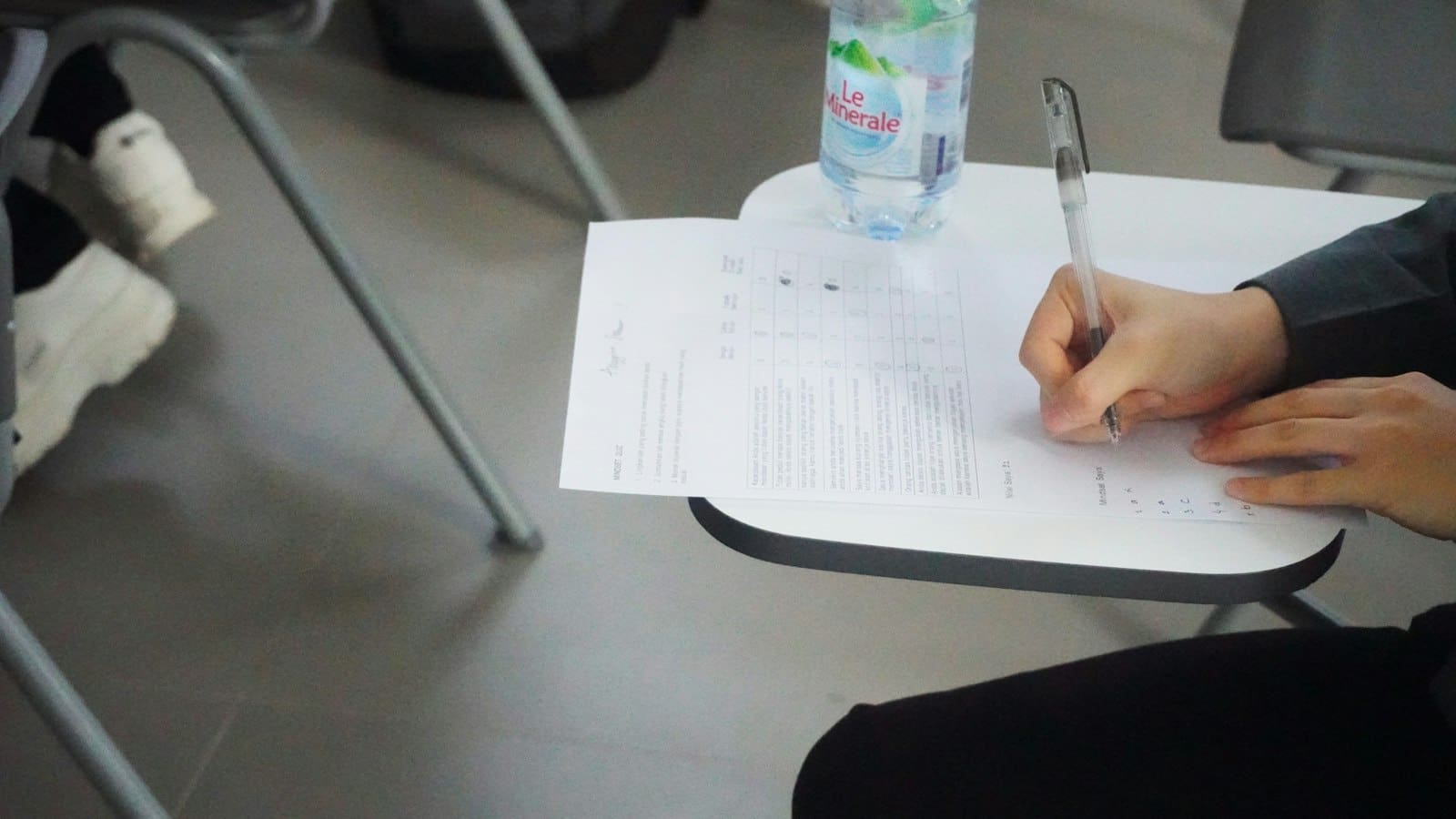
The envelope, or more likely the app notification, arrives on a Thursday evening. Your child mentions the maths mock in passing, a little too casually, and the number is lower than either of you hoped. Or it is a grade 5 when the sixth form wants a 6. By the time they have gone up to bed, you have read it three times and started wondering what it means for May.
You’re not alone in this. GCSE maths mock results are among the most read-into numbers of Year 11, and they usually say less than they seem to.
TL;DR: A maths mock is a snapshot taken five or six months before the real exams, usually marked against an earlier year’s grade boundaries. It shows which topics and which kinds of question are losing marks, and it is a weaker guide to any one student’s final grade. Use it to plan the next few months, check the tier decision before the entry deadline of 21 February 2027, and keep the grade itself in proportion. The real papers are on 14 May, 27 May and 14 June 2027.
What a mock grade is
Schools set their own mocks, at a time that suits them, and mark them in-house. Grade boundaries for the real exams are only set after each summer’s papers have been marked, so a school has to borrow boundaries from an earlier year to turn a mock score into a grade. It is a reasonable way round the problem, and it carries a margin of error.
Boundaries move from year to year and between boards. In June 2026, a grade 4 on AQA’s Higher tier needed 63 marks out of 240; on Pearson Edexcel’s Higher tier it needed 50. A few marks either way can move a mock grade up or down without anything about your child’s maths changing.
What GCSE maths mock results can tell you
- Which topics are costing marks. The most useful thing a mock gives you. Ask for the paper back, or at least a breakdown by question.
- Which kind of question goes wrong. Is it the long problem-solving questions, careless slips on early questions, or running out of time? Each has a different fix.
- How the non-calculator paper compares with the calculator ones. A big gap between them usually points to arithmetic fluency rather than understanding.
- Whether the tier looks right. More on that below.
What it cannot tell you
Not the final grade. Five or six months of teaching, practice and growing up sit between the mock and the summer, and many students sit the mock before the whole course has been taught.
Teachers’ own predictions, made much nearer the exams, show the same pattern. FFT Education Datalab looked at teacher predictions made in May and June across hundreds of schools and found they “tend to match results quite closely at the cohort-level, but not at the pupil-level”. Maths was one of the more accurate subjects, and even so a large share of individual predictions did not match the final grade. Those were predictions made weeks before the exams. A mock in the winter is further out still.
It also cannot tell you how your child felt on the day. A mock sat in a cold sports hall after a bad night’s sleep is information about that morning as much as about maths.
The tier question
GCSE maths has two tiers. Foundation covers grades 1 to 5. Higher covers grades 4 to 9, with a grade 3 allowed as a safety net. The mock is often the point at which a school confirms or changes a student’s tier, and the numbers can look strange side by side. In June 2026, AQA’s grade 4 needed 154 out of 240 on Foundation but only 63 out of 240 on Higher.
| June 2026, marks out of 240 | Grade 4 | Grade 5 | Grade 7 |
|---|---|---|---|
| AQA Foundation | 154 | 187 | not available |
| AQA Higher | 63 | 97 | 166 |
| Pearson Edexcel Foundation | 151 | 181 | not available |
| Pearson Edexcel Higher | 50 | 82 | 146 |
The low Higher boundary does not make Higher the safer route to a 4. The questions are harder from the first page, and a student who falls below the grade 3 safety net (46 marks on AQA Higher in 2026) leaves with a U, when the same student might have earned a 4 on Foundation. Our guide to choosing Foundation or Higher goes through the decision in detail.
Schools send their summer entries to the exam boards by 21 February 2027. Changing tier after that is still possible, but Pearson Edexcel charges a fee for a tier change from 22 April 2027, other boards set their own dates, and schools understandably prefer to settle it early. If you have a question about the tier, raise it with the maths teacher soon after the mock.
What to do in the next few weeks
- Get the detail, not only the grade. Ask the school for the marked paper or a question-by-question breakdown.
- Sit down with your child and make a short list. Five or six topics or question types that cost the most marks. Keep it calm and keep it short.
- Put a little practice on that list each week. Twenty to thirty minutes, two or three times a week, on one item at a time. Free sites such as Corbettmaths and Maths Genie are excellent for this, and our article on using Corbettmaths, Maths Genie and Dr Frost together shows how.
- Check the tier. If the mock has raised a question about Foundation or Higher, talk to the maths teacher before February.
- Plan a few timed papers for the spring. One every week or two from February is plenty, with the marking done together afterwards.
Talking about the result at home
Many parents feel they need to react strongly to a disappointing mock, to show it matters. Most teenagers already know it matters. What helps more is curiosity about what went wrong and a plan they had a hand in making. “Let’s see which questions cost the most” lands better than “you need to work harder”, and it leads somewhere useful.
If the result was good, the same approach works. A strong mock still has a list of lost marks, and that list is where the next few marks are.
FAQ
Are GCSE maths mock results accurate?
They are a useful guide to what needs work, but a weaker guide to one student’s final grade. Mocks are sat months before the exams and usually graded with an earlier year’s boundaries, which change every year.
Which grade boundaries do schools use for mocks?
Usually an earlier year’s, because the boundaries for the real exams are only set after the summer papers are marked. In June 2026, a grade 4 on AQA Higher needed 63 out of 240 and on Pearson Edexcel Higher it needed 50.
Can my child change tier after the mock?
Yes. Schools send entries by 21 February 2027, and a tier change later in the spring can cost the school a fee (from 22 April 2027 with Pearson Edexcel). Talk to the maths teacher soon after the mock if you think the tier is wrong.
When are the GCSE maths exams in 2027?
On the mornings of Friday 14 May, Thursday 27 May and Monday 14 June 2027 for AQA and Pearson Edexcel. Results day is Thursday 19 August 2027.
What should we do after a disappointing maths mock?
Get the marked paper, make a short list of the topics and question types that cost the most marks, and work on one at a time, little and often. Check the tier with the teacher before February.
Tracy’s take
I have seen plenty of students with a disappointing mock go on to do well in the summer, and a few with a comfortable mock coast and drop a grade. The difference is almost never talent. It is whether the mock was used as a map or taken as a verdict.
If you would like help reading your child’s mock paper and turning it into a plan, or a few one-to-one sessions on the topics at the top of the list, get in touch. Our free CPCC resources have more on keeping maths conversations at home calm, and our GCSE maths page covers the course as a whole.
Information, not advice. Grade boundaries are from AQA and Pearson for June 2026; dates are from JCQ, AQA and Pearson, checked on 8 November 2026. Your child’s school decides tier entries, so talk to them before making changes.